
Which One Needs Me
I used to keep a terminal window open for each agent. Up to about 3, I could follow them (that's a rough number), but at 10 I was spending too much time switching windows with alt-tab. Once I found an agent that had been waiting at a permission prompt for 9 minutes.
I wanted to see which agent needed me without opening every window. This setup doesn't improve the code they write. It helps me manage them, whether I'm running 4 agents or 20.
I use Ghostty with herdr, 23 keybindings and about 220 lines of shell.
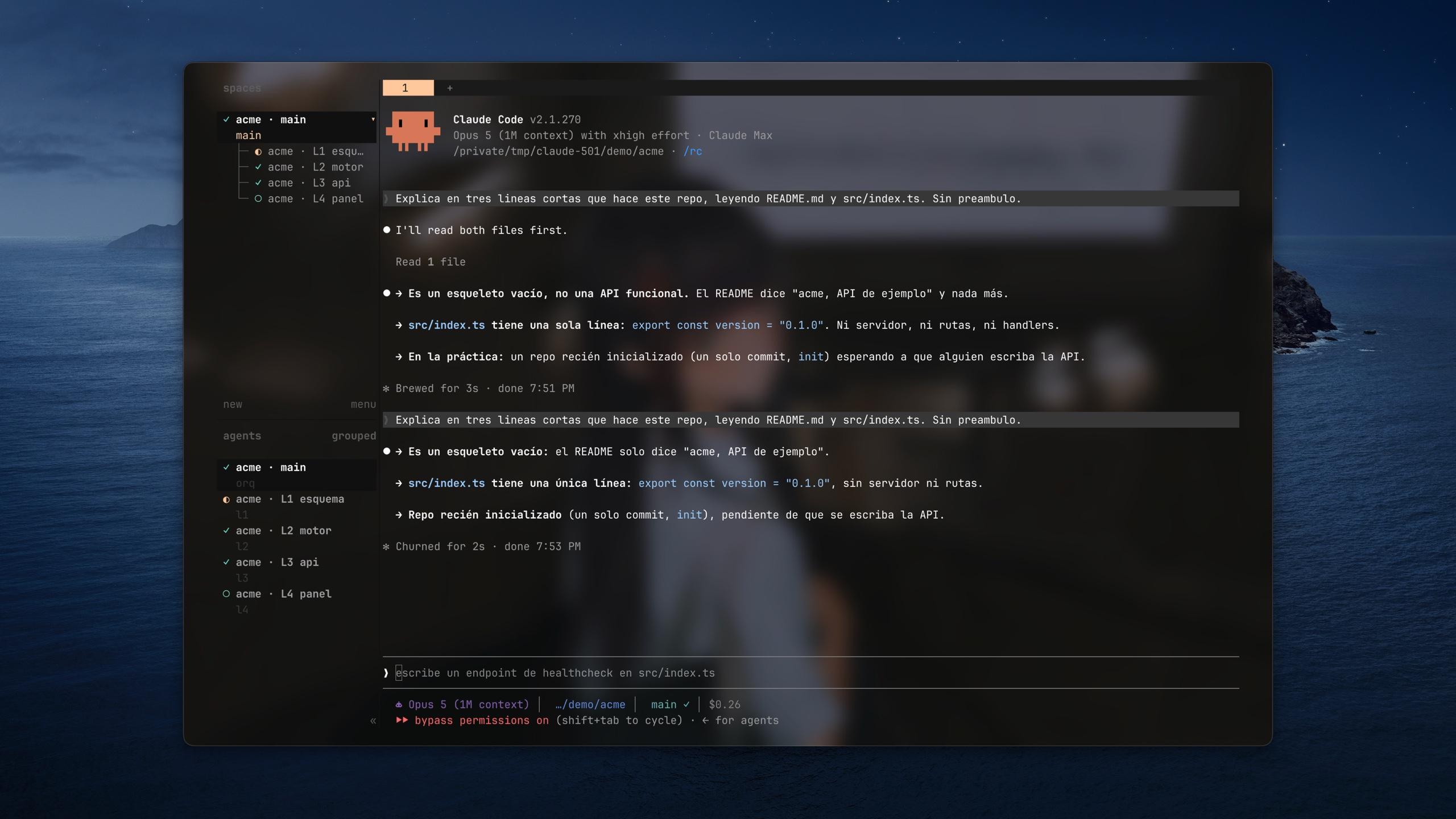
How I give them work
The terminal config, keys and worktrees are in The Setup Underneath. Here I want to explain how I pass work to the agents and get the result back. I would've liked an example of this when I started.
There are three levels. Each checks the work and writes a summary, so the level above doesn't have to read everything. All three orchestrators use Claude Code. They don't edit code. They investigate, check and report back. The agents in the lanes write the code, each in its own worktree.
I only talk to the main orchestrator. If a lane needs a decision, it asks its sub-orchestrator, which passes it to the main one. Before asking me, the main orchestrator checks the other work going on too, so I can have 16 panes open and still follow one conversation in one window.
If I answer a lane directly, that's another conversation I have to follow, which fragments context, so I don't.
Why keep the middle level? I need it investigating and reviewing while the lanes write. Mine often returns saying it touched nothing, which is the right call when it hasn't found enough evidence yet. At the end it reads the four branches, checks which lanes said they were done but weren't, and puts the commits in order for the merge.
The lane sends the result back to the orchestrator that briefed it, because a ready branch doesn't mean it's done.
I use three agent kinds, depending on what a mistake would cost. Claude Code makes the calls at every orchestrator level, while the lanes use Devin on SWE-2 and Gemini Flash 3.8 through agy. They're fast and cheap, and by then the work is already clear enough that I can check if they've finished it.
The briefing
Once it's checked the problem, the orchestrator writes a briefing with six parts.
Take the voice failing in staging: once the orchestrator's checked it, here's what it sends to the lane:
1 objective   voice is broken in staging. the cause is in the
              other service, not in ours. confirm it and say
              what they need to change.
2 symptom     the endpoint we call answers 403 today. nothing
              changed on our side.
3 chain       our service -> their endpoint -> 403. the first
              two links verified on our side, the third in
              their logs.
4 history     the same endpoint answered 201 three days in a
              row. a regression, not something that never
              worked.
5 ruled out   our request and our config. paths and line
              numbers go here, so nobody reopens them.
6 boundaries  do not touch our service. if the right fix is
              configuration and not code, say so and do not
              write code. answer in a few lines: what to
              change, and on whose side.
Part 1 says what to do and which service isn't at fault. Part 4 tells the next agent this used to work (the endpoint returned 201 before it returned 403), because leaving that out lets it go looking for why this has never worked.
Part 5 is easy to skip, but then the next agent spends its first 20 minutes checking what the last one already ruled out, paying the tokens again and making it harder to know what was actually checked. Put the paths and line numbers in there.
I took a while to get part 6 right. Specifying "if the right fix is configuration and not code, say so and do not write code" tells the agent it's fine to come back without a patch. Otherwise I ask about a bug and get a code change, even when it didn't need one. Saying it directly is the only way that's worked for me.
For this staging example, I'd expect a few lines asking for a config change in the other service, with no patch on our side. That goes back through the sub-orchestrator to the main one, and I get it with the other decisions for the day, without having to ask the lane what happened.
Messages between agents
Messages start with the sender, like orq-main: URGENT — …. orq is just what I call an orchestrator. The other agent sees who's asking and how much weight to give it. If the case is in another domain, it goes to the orchestrator that knows that area with the same six-part briefing, so they don't have to explain everything again.
I look for two habits, and if either's missing, I change the orchestrator.
It has to correct me. One report this week opened with "Premise corrected: the UF is ISO 4217." The work had started from the opposite assumption and the first line said so: good. Tell me early, even if that means we have to look somewhere else.
It also has to ask when it doesn't know. Asking "Do I have access to the staging logs, or do you pull them?" takes seconds, whereas a guess can cost an afternoon, and I might only find out later that it hadn't used the logs.
What I watch
I follow the agents in the sidebar without watching their panes. I leave an agent that's working alone, and one that's done can wait. When it's blocked, I need to check. alt+a moves only between agents, so I can reach it in a press or two.
My job stays on the decisions: I read the reports and decide what happens next.